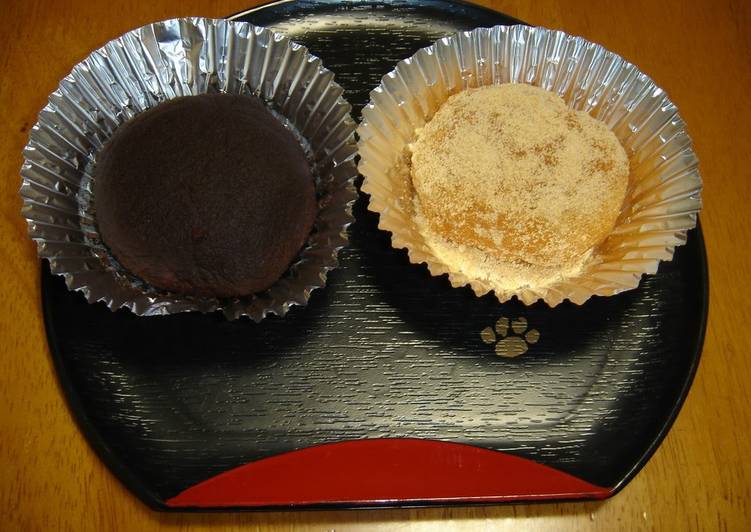
Hello everybody, I hope you’re having an incredible day today. Today, I will show you a way to make a special dish, ohagi (to freeze-store for later). One of my favorites. This time, I’m gonna make it a bit unique. This is gonna smell and look delicious.
Wash the sticky and plain rice together. When you're ready to eat, defrost overnight in the refrigerator. To bring back the ideal texture, Ohagi Ohagi (Botamochi) are not so sweet and they go really well with green tea.
Ohagi (to freeze-store for later) is one of the most favored of recent trending foods on earth. It is appreciated by millions every day. It is simple, it is fast, it tastes delicious. Ohagi (to freeze-store for later) is something which I’ve loved my whole life. They are fine and they look fantastic.
To begin with this recipe, we must first prepare a few components. You can cook ohagi (to freeze-store for later) using 12 ingredients and 16 steps. Here is how you can achieve that.
The ingredients needed to make Ohagi (to freeze-store for later):
- Prepare 1 raw rice : 1 1/2 rice cooker cup Sticky rice
- Get 1 raw rice : 1/2 rice cooker cup Plain rice
- Make ready 1 tsp Sugar
- Prepare 50 ml Salt water
- Prepare Red bean ohagi
- Take 400 grams Powdered koshi-an
- Get 120 grams Sugar
- Take 1 pinch Salt
- Take Kinako ohagi
- Take 3 tbsp Kinako
- Get 3 tbsp Sugar
- Prepare 1 pinch Salt
Recursively freezes the current state, the dispatched action payload if provided and the new state. When mutation occurs, an exception will be thrown. Should be used only in development to ensure that the state remains immutable. This ohagi recipe provides instructions for making traditional Japanese desserts/sweets out of azuki red beans and mochi rice cakes.
Instructions to make Ohagi (to freeze-store for later):
- Wash the sticky and plain rice together.
- Let soak in water for 1 hour.
- Once it's done soaking, move the rice to a rice cooker bowl, stir in the sugar, and fill water to the "white rice" line. Adding sugar prevents the sticky rice from becoming too hard.
- While the rice is cooking, prepare the anko. I used this particular powdered koshi-an this time.
- Combine the anko with the amount of water indicated on the package, add sugar, and heat. It will be fairly gooey at first.
- Cook until it's the desired thickness.
- Now prepare the kinako. The kinako-sugar ratio is 1:1, so prepare as much as you like to make. I made 3 tablespoons this time.
- Once the rice is finished, let steam for 10 minutes. Dip a rolling pin or similar rod damped with salt water to slightly mash the rice.
- Moisten a paper towel and wring out excess water. If you don't have paper towels, use cling wrap or a tightly wrung towel.
- Spread bean paste on the paper towel and place the rice on top. Grab enough rice for one ohagi from the rice cooker and cover the rest when not in use.
- You can eyeball the amount of bean paste and rice. It should look something like this.
- Use your fingers to gently stretch the bean paste completely around the rice.
- If the paper towel gets particularly dirty, wash, wring it out, and use it again.
- Since the kinako is just for sprinkling on the outside of the ohagi, they will end up slightly smaller than the ones wrapped in bean paste, so add a bit more rice to make the sizes similar.
- Wrap extra ohagi in cling wrap to prevent drying and freeze.
- These are covered in kinako, but when you defrost the ohagi, the kinako tends to melt, so I recommend defrosting first, then covering with kinako.
Commonly enjoyed in Japan during the autumn equinox or during O-bon (a festival for honouring the spirits of one's ancestors), ohagi are made with glutinous mochi rice. Japanese artist Ohagi truly lives the "Kawaii" cartoon style. Learn how she draws her cute characters. Normal Mode Strict Mode List All Children. We're working hard to be accurate.
So that is going to wrap this up with this special food ohagi (to freeze-store for later) recipe. Thanks so much for reading. I am sure you will make this at home. There’s gonna be more interesting food in home recipes coming up. Don’t forget to save this page on your browser, and share it to your family, colleague and friends. Thank you for reading. Go on get cooking!