Hey everyone, hope you are having an incredible day today. Today, I will show you a way to make a special dish, halloween wagashi - kabocha squash mochi. One of my favorites food recipes. This time, I’m gonna make it a bit unique. This is gonna smell and look delicious.
Kashiwa mochi, made from rice flour, joshinko (high quality flour of non-glutinous rice), is enjoyed for the chewiness imparted by the rice and its lightly sweetened taste. Spread batter into the cupcake pan. Place one piece of kabocha in the center of each muffin.
Halloween Wagashi - Kabocha Squash Mochi is one of the most favored of recent trending meals in the world. It’s simple, it is fast, it tastes delicious. It is enjoyed by millions every day. Halloween Wagashi - Kabocha Squash Mochi is something which I’ve loved my whole life. They’re nice and they look fantastic.
To get started with this particular recipe, we have to first prepare a few ingredients. You can cook halloween wagashi - kabocha squash mochi using 7 ingredients and 10 steps. Here is how you cook that.
The ingredients needed to make Halloween Wagashi - Kabocha Squash Mochi:
- Make ready 20 grams A. Kabocha squash
- Prepare 30 grams A. Shiratamako
- Take 12 grams A. Sugar
- Take 50 grams A. Water
- Get 75 grams Koshi-an
- Make ready 1 for dusting Katakuriko
- Take 5 Pumpkin seeds, pine nuts, etc. (for the stem)
These delicious traditional snacks come in a compact-sized pack. Anyone know Omocha no cha cha cha? It's a children's song that just popped into my head as I was thinking about kabocha. It's round and bright orange on the inside.
Steps to make Halloween Wagashi - Kabocha Squash Mochi:
- Prep the kabocha squash by peeling, microwaving until tender, then mash. Divide the koshi-an into 5 portions.
- Put the A. ingredients in a heatproof bowl, and mix together well with a whisk. Cover with plastic wrap and microwave (about 1 minute 40 seconds at 700 W).
- Knead with a spatula until the dough is smooth.
- Lay the dough on a work space dusted with katakuriko and cut into fifths (the dough is quite sticky and difficult to work with, so dust your workspace with a lot of katakuriko).
- Flatten each portion into a circle, and wrap around the balls of koshi-an.
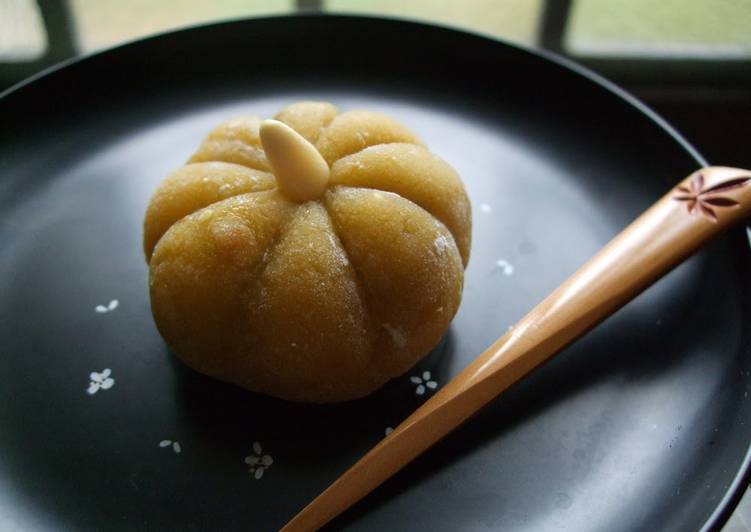
- Press the back of a knife onto the surface to make the kabocha squash pattern.
- When the dumplings are formed, brush off any excess katakuriko on the surface with a brush. This improves their appearance.
- Decorate the tops with a pumpkin seed or similar to finish. I didn't have any pumpkin seeds, so I used pine nuts.
- Soft and tender yellow gyuuhi wrapped around not-too-sweet, homemade koshi-an. You can see the yellow color of the kabocha squash inside too, and it looks pretty.
- I put some kabocha squash paste into the koshi-an too. It looks beautiful and tastes great too. Give it a try!
Fukusa mochi (ふくさ餅), as it is called, is a treat for the tastebuds due to its various textures — upon biting into it, one first enjoys the softness of the pancake-like skin, before that gives way to the smoothness of the red bean paste, and finally the chewiness of the mochi hidden within. The Korean danhobak is a kind of winter squash, known by its Japanese name kabocha in English. In Korean, dan means "sweet," and hobak means "pumpkin," and bap means "rice," so you could translate this dish as "sweet pumpkin rice." A danhobak is very sweet and fluffy when cooked, so I often steam it and eat it by itself. The texture is very similar to sweet potato. White Bean Paste or Shiroan is commonly used as a filling for wagashi (Japanese confectionery) such as mochi and manju.
So that’s going to wrap it up with this exceptional food halloween wagashi - kabocha squash mochi recipe. Thanks so much for your time. I’m sure that you will make this at home. There is gonna be more interesting food in home recipes coming up. Don’t forget to bookmark this page on your browser, and share it to your family, friends and colleague. Thanks again for reading. Go on get cooking!