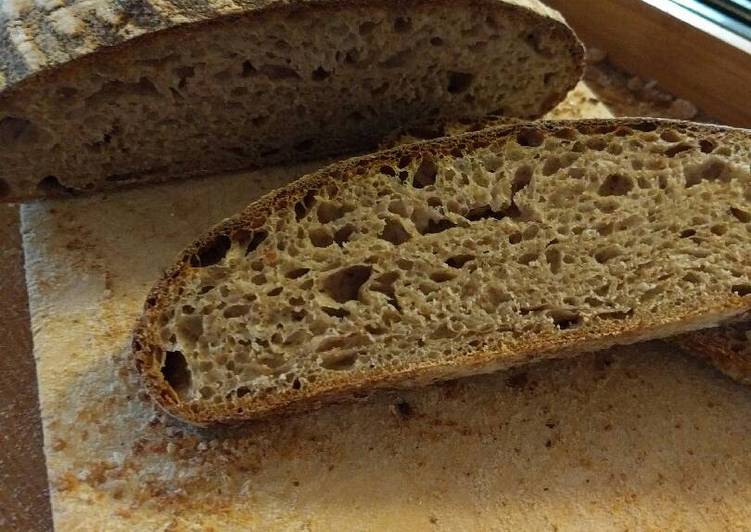
Hello everybody, hope you’re having an amazing day today. Today, I will show you a way to prepare a special dish, slow fermented (non retarded) wholemeal sourdough. One of my favorites. This time, I will make it a little bit tasty. This will be really delicious.
Slow fermented (non retarded) wholemeal sourdough is one of the most well liked of current trending foods in the world. It’s appreciated by millions every day. It’s simple, it’s quick, it tastes yummy. Slow fermented (non retarded) wholemeal sourdough is something which I’ve loved my entire life. They’re fine and they look fantastic.
Slow fermented whole spelt sourdough bread. Let me say right from the start that I am not a measuring kinda guy when it comes to my bread. Add ½ cup of water, ½ cup of wholemeal spelt flour, stir well, cover with muslin (or similar), and leave in a.
To get started with this recipe, we must prepare a few ingredients. You can have slow fermented (non retarded) wholemeal sourdough using 5 ingredients and 18 steps. Here is how you can achieve that.
The ingredients needed to make Slow fermented (non retarded) wholemeal sourdough:
- Get 150 g sourdough starter
- Get 200 g very strong white flour
- Get 385 g strong wholemeal flour
- Prepare 420 ml cold water
- Make ready 14 g salt
After removing from the refrigerator, the dough will need to be brought to room temperature and given any extra proofing time necessary to reach the volume called for before moving on to the next step. Organic Flour vs Non-Organic Flour for Sourdough Bread. When it comes to sourdough bread, we Non-organic flours are often bleached, which means they are chemically treated to whiten and age Stone ground flour has made a bit of a comeback in recent years and shows no sign of slowing down. In this video I take you through how to switch your starter to a wholemeal starter and what differences that will make in your schedule and for your bread!
Instructions to make Slow fermented (non retarded) wholemeal sourdough:
- Mix together the starter and the flours, with almost all of the water (hold back a couple of spoonfuls)
- Leave to autolyse for 30 mins.
- Mix the salt with the remaining water.
- Distribute the salty water evenly over the dough
- Using a stand mixer with a dough hook (on a low speed) or by hand - knead very well for 15-20 minutes until dough is very strong and well developed
- Cover the bowl and leave to rise for 24 hours at (cool) room temperature
- Divide dough in two and pre-shape on a lightly floured surface
- I now like to freeze one half - tightly wrapped in clingfilm
- After a 5-10 minute rest, tightly shape the dough and place in a proving basket or tin
- Leave to rise for another 18-24 hours until doubled in size / full of gas
- Preheat oven to 240°C for 30 mins
- Turn out dough onto your baking surface and slash with an oiled razor blade
- Throw a half cup of water into the bottom of the oven
- Add the dough and turn down heat to 210°C
- Bake for 20 mins and reduce heat to 200°C
- Bake for a futher 20 mins.
- If crust still needs to be darker then turn off oven and leave bread inside for 10-15 mins
- Cool, then eat
This method involves getting your dough fermenting and then finishing the prove in the fridge. This is typical of the style of sourdough baked in San Francisco. All it takes to make it look really attractive is a couple of slashes after the The joy of sourdough bread baking for me lies in the slow development over time… a true Longer ferments need less leaven. Too much and it will over prove, especially wholemeal flour. Generally with sourdough after the bulk ferment (before shaping) you don't "knock back" - that's just taking out all the air and hoping there's enough Some of our sourdoughs we will make to cover two days of bakes.
So that’s going to wrap it up with this special food slow fermented (non retarded) wholemeal sourdough recipe. Thanks so much for reading. I am sure you will make this at home. There is gonna be more interesting food in home recipes coming up. Remember to save this page on your browser, and share it to your family, friends and colleague. Thank you for reading. Go on get cooking!