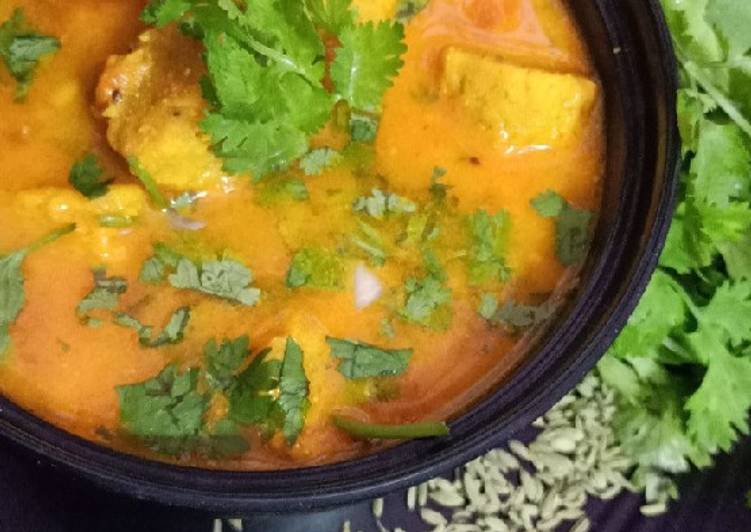
Hello everybody, I hope you are having an incredible day today. Today, we’re going to make a distinctive dish, rajasthani gatte ki sabji. It is one of my favorites. This time, I’m gonna make it a little bit tasty. This will be really delicious.
Rajasthani gatte ki sabzi also known as besan ke gatte is one such authentic dish from Rajasthani cuisine. The popularity of gatte ki subzi or gatta curry has now widely spread beyond Rajasthan to other parts of India. It's best enjoyed during winter or rainy days and like most of the Rajasthani dishes it is bit high on spiciness.
Rajasthani gatte ki sabji is one of the most popular of current trending meals on earth. It’s enjoyed by millions every day. It’s easy, it is fast, it tastes yummy. Rajasthani gatte ki sabji is something which I’ve loved my entire life. They’re fine and they look fantastic.
To begin with this recipe, we have to first prepare a few components. You can have rajasthani gatte ki sabji using 13 ingredients and 6 steps. Here is how you cook that.
The ingredients needed to make Rajasthani gatte ki sabji:
- Make ready 1 cup gram flour
- Make ready 1/2 cup curd
- Get 2 finely chopped onion
- Take 2 finely chopped tomato
- Take 1 tsp fennel seeds
- Prepare 1 tsp mustard seeds
- Make ready 1 tbsp kasuri methi
- Prepare 1 tbsp ginger garlic paste
- Get to taste Turmeric powder red chilli powder salt
- Take 4 tbsp Oil
- Prepare as required Mustard oil for gravy
- Take as required Coriander leaves
- Prepare 3-4 pinches asafoetida
There are many variations of making Rajasthani gatte ki sabzi. At home we make a Punjabi version of gatte ki sabzji with an onion-tomato gravy where curd is not added. Gatte ki sabzi, an authentic dish from Rajasthani cuisine is a delicious curry prepared with gram flour as base ingredient. Gatte means cooked gram flour dumplings, which are added to the spicy curd gravy to make this irresistible curry.
Steps to make Rajasthani gatte ki sabji:
- First take any mixing bowl Add gram flour spieces to taste Coriander leaves kasuri methi salt to taste.after that add oil mix it with hand and pour little pour to make a dough. Grease some oil in hand and also apply on dough,roll out them with 1-2 inch and make a 3-4 inch long logs.place it on the plate.
- Meanwhile heat some water in a vessel to boil the gatta.when you see gentle boil is coming in the water,drop gatta on by one. Boil it for 10 mintues.drain out the gatta from water and we use left over water in gravy
- Now heat a pan pour mustard oil when the oil is hot add fenugreek seeds, mustard seeds asefoetia when it crackles add chopped onion when becomes pink in colour add ginger garlic paste all spices and salt saute it for few minutes.
- Add tomatoes and mix it well with spatula.Now take whisked curd pour it in pan, saute the masala until you see oil living it's edges stir regularly Your masala.
- Meanwhile cut logs in 1/2 inch chunks.when masala start simmering add gatta cook for few minutes and add leftover water stir occasionally.try to make it little thin otherwise gatte will absorb the gravy.If more water is needed, you can add in gravy.
- Let it simmer for 5 minutes.so that the gatte will absorb gravy. Transfer Your curry in a bowl and garnish with fresh coriander leaves.
It tastes best when served with roti or any delicious Indian flat bread, dal and plain rice in lunch. About Gatte Ki Sabzi Recipe: A delight from the Rajasthani cuisine, Gatte are basically cooked gram flour dumplings which are added to the spicy curd gravy. It can be served for lunch or dinner in. Gatte ki sabzi or Gatta curry is a very popular and traditional curry from Rajasthan. Rajasthan is a dry climate state and so they have less availability of fresh vegetables,,hence they use much of flours,grains and pulses.
So that is going to wrap this up for this exceptional food rajasthani gatte ki sabji recipe. Thanks so much for your time. I am sure you can make this at home. There is gonna be interesting food in home recipes coming up. Don’t forget to save this page in your browser, and share it to your family, friends and colleague. Thank you for reading. Go on get cooking!